
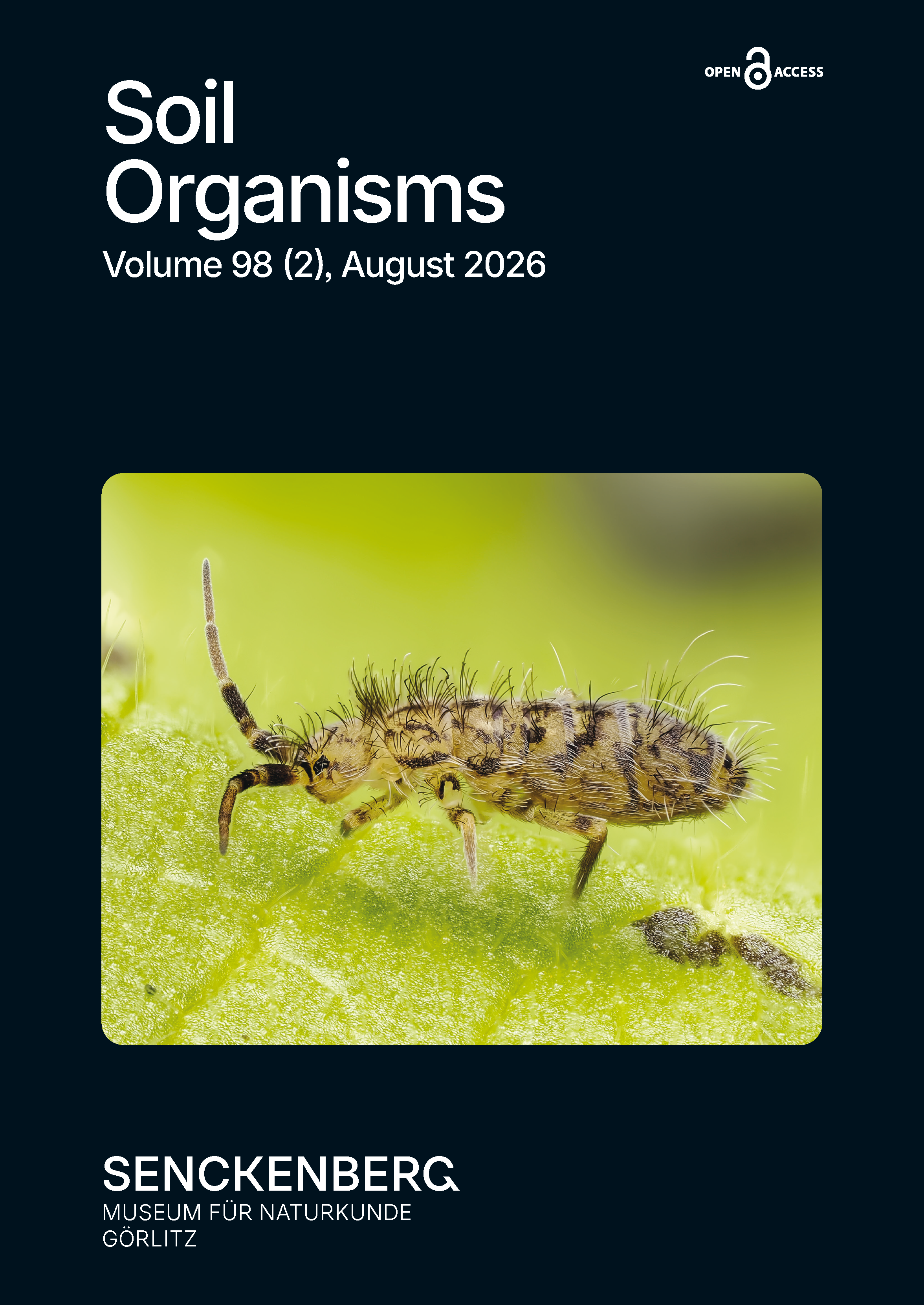
Nocturnal activity in the arboreal Collembola Willowsia japonica (Folsom, 1987)
DOI:
https://doi.org/10.25674/500Keywords:
Willowsia japonica, nocturnal activity, precipitation, tree trunk, baiting techniqueAbstract
The diel cycle of Willowsia japonica was studied using traps on the tree trunk during the summer months. W. japonica was more active during nighttime than daytime on the trunk of Quercus crispula throughout summer, regardless of body size. The difference was, however, blurred by precipitation, which activated W. japonica even during daytime. However, precipitation increased diurnal activity levels and decreased the difference between daytime and nighttime abundance. Although other springtails such as Desoria spatiosa, Subisotoma sp., and Tomocerus aokii, as well as woodlice were more sensitive to respond to moisture than W. japonica, W. japonica is considered relatively tolerant to desiccation among springtails. Its diel cycle of activity still appears to be shaped by environmental moisture. We also found that the proportion of individuals with discernible gut contents did not significantly differ between night and day, but smaller individuals were more likely to have filled guts, suggesting that juvenile W. japonica feed at a higher rate than adults. In conclusion, the physiology of Collembola necessitates a relationship between activity levels and environmental moisture, even in species considered desiccation-tolerant such as W. japonica.
Downloads
References
Bauer, T. (1979). Die feuchtigkeit als steuernder Faktor für das kletterverhalten von Collembolen. Pedobiologia, 19, 165–175.
Bellinger, P. F., Christiansen, K. A., & Janssens, F. (1996–2024). Checklist of the Collembola of the World. http://www.collembola.org
Bowden, J., Haines, I. H., & Mercer, D. (1976). Climbing Collembola. Pedobiologia, 16, 298–312. https://doi.org/10.1016/S0031-4056(23)02178-9
Brooks, M. E., Kristensen, K., van Benthem, K. J., Magnusson, A., Berg, C. W., Nielsen, A., Skaug, H. J., Maechler, M., & Bolker, B. M. (2017). glmmTMB balances speed and flexibility among packages for zero-inflated generalized linear mixed modeling. The R Journal, 9, 378–400. https://doi.org/10.32614/RJ-2017-066
Choi, W. I., Moorhead, D. L., Neher, D. A., & Ryoo, M. I. (2006). A modeling study of soil temperature and moisture effects on population dynamics of Paronychiurus kimi (Collembola: Onychiuridae). Biology and Fertility of Soils, 43, 69–75. https://doi.org/10.1007/s00374-005-0062-5
Davies, W. M. (1927). On the tracheal system of Collembola, with special reference to that of Sminthurus viridis, Lubb. Journal of Cell Science, s2-71(281), 15–30.
Farrow, R. A., & Greenslade, P. (1992). A vertival migration of Collembola. The Entomologist, 111, 38–45.
Fox, A. D., & Stroud, D. A. (1986). Diurnal rhythms in a snow-surface springtail (Isotoma violacea, Collembola) and its predators in Eqalungmiut Nunaat, West Greenland. Pedobiologia, 29, 405–412. https://doi.org/10.1016/S0031-4056(23)06918-4
Frampton, G. K., Van den Brink, P. J., & Wratten, S. D. (2001). Diel activity patterns in an arable collemboan community. Applied Soil Ecology, 17, 63–83.
Hågvar, S. (2000). Navigation and behaviour of four Collembola species migrating on the snow surface. Pedobiologia, 44, 221–233.
Hisamatsu, M., & Itoh, R. (1997). Growth and fecundity of Collembolan species, Willowsis japonica, under experimental conditions. Journal of the College Arts & Sciences, Showa University, 28, 123–131. [In Japanese]
Ichisawa, K. (2015). Entomobryidae/Orchesellidae. In J. Aoki (Ed.), Pictorial keys to soil animals of Japan (2nd ed., pp. 1354–1396). Tokai University Press. [In Japanese]
Ito, R. (1991). Growth and life cycle of an arboreal Collembola, Xenylla brevispina Kinoshita, with special reference to its seasonal migration between tree and forest floor. Edaphologia, 45, 33–48.
Kaneda, S., & Kaneko, N. (2011). Influence of Collembola on nitrogen mineralization varies with soil moisture content. Soil Science and Plant Nutrition, 57, 40–49. https://doi.org/10.1080/00380768.2010.551107
Matsumoto, N., Suma, Y., & Koike, T. (2018). Reproduction and growth of Collembola under snow in a cold temperate region. Edaphologia, 102, 11–21. https://doi.org/10.20695/edaphologia.102.0_11
Matsumoto, N., & Suma, Y. (2023). Life cycle and scale development in Willowsia japonica (Collembola: Entomobrydae). Journal of the Natural History of Aomori, 28, 106–112. [In Japanese]
Matsumoto, N., Suma, Y., & Watanebe, T. (2025). Arboreal collembola fauna in Chitose, Hokkaido. Journal of the Natural History of Aomori, 30, 30–36. [In Japanese]
McGillycuddy, M., Warton, D. I., Popovic, G., & Bolker, B. M. (2025). Parsimoniously fitting large multivariate random effects in glmmTMB. Journal of Statistical Software, 112, 1–9. https://doi.org/10.18637/jss.v112.i01
Meteorology Agency of Japan. (2024–2025). Meteorological data service. https://www.data.jma.go.jp/stats/etrn/index.php
Nekhaeva, A. A., Babenko, A. B., Bzin, M. S., & Sozontov, A. N. (2024). Diurnal activity of terrestrial arthropods in the High Arctic. Polar Biology, 47, 1077–1092. https://doi.org/10.1007/s00300-024-03278-1
R Core Team. (2025). R: A language and environment for statistical computing. R Foundation for Statistical Computing. https://www.R-project.org
Shaw, P. (2015). How high do Collembola climb? Studies of vertical migration in arboreal Collembola. Soil Organisms, 87, 229–235. https://soil-organisms.org/SO/article/view/292
Suma, Y., Watanabe, T., & Matsumoto, N. (2025). Collembola from the forest floor in Chitose, Hokkaido. Journal of the Natural History of Aomori, 30, 37–42. [In Japanese]
Uchida, H., & Fujita, K. (1968). Mass occurrence and diurnal activity of Dicyrtomina rufescens (Collembola: Dicyrtomidae) in winter. Science Report of the Hirosaki University, 15, 36–48.
Yoshii, R. (1992). Identity of some Japanese Collembola. Acta Zoologica Asiae Orientalis, 2, 97–110.
Downloads
Published
Issue
Section
License
Copyright (c) 2026 Naoyuki Matsumoto, Yasuhiko Suma, James McCulloch

This work is licensed under a Creative Commons Attribution 4.0 International License.
Soil Organisms is committed to fair open access publishing. All articles are available online without publication fees. Articles published from Vol. 96 No. 3 (2024) onwards are licensed under the Creative Commons Attribution 4.0 International (CC BY 4.0) license. Articles published from Vol. 80 No. 1 through Vol. 96 No. 2 are available under the previous terms, allowing non-commercial, private, and scientific use.
 Bluesky