Microarthropod Assemblages on Edible and Toxic Mushrooms in Northwestern Patagonia: Influence of Hymenophore Structure and Fungal Toxicity
DOI:
https://doi.org/10.25674/484Keywords:
Agaricus, mushroom, Collembola, Oribatida, microarthropodsAbstract
We investigated microarthropod communities associated with 20 mushroom species in Northwestern Patagonia, including both edible and toxic fungi. Our study examined whether hymenophore structure (lamellar vs. tubular) and edibility or toxicity influence microarthropods abundance, richness, and diversity. Over 65,000 individuals were collected, representing 98 species. Collembola and Oribatida were identified to species level. Mushrooms with lamellar hymenophores supported higher total abundance and greater Diptera richness and diversity, while tubular fungi harbored significantly more Acari. Contrary to our initial expectation, the toxic species Amanita muscaria, exhibited high diversity. These findings highlight the role of mushrooms as ecological hubs for arthropod diversity, regardless of their edibility our results provide new insights into the role of fungal traits in structuring microarthropod assemblages and suggest avenues for further research on fungal–arthropod networks in temperate forests.
Downloads
References
Amendt, M. J., Goff, L., Campobasso, C. P. & Grassberger, M. (2010). Current concepts in forensic entomology. Springer Science - Business Media B.V.
Balogh, J., & Balogh, P. (1988). Oribatid mites of the Neotropical region I (p.335). Elsevier.
Balogh, J., & Balogh, P. (1990). Oribatid mites of the Neotropical region II (p.333). Elsevier, Amsterdam/Akadémiai Kiadó.
Balogh, J., & Csiszár, J. (1963). The zoological results of Gy. Topal’s Collectings in South Argentina 5. Oribatei (Acarina). Annales Historico Naturales Musei Nationalis Hungarici Pars Zoologica, 55, 463–485.
Bellinger, P. F., Christiansen, K. A., & Janssens, F. (2024). (Access 2025, July 10): Checklist of the Collembola of the world. http:// www. collembola.org.
Bernava, V., & Palacios Vargas, J. G. (2000). Collembola. In L. Claps, G. Debandi, & S. Roig (Eds.), Biodiversidad de Artrópodos Argentinos Vol. 2, pp. 151–166. Sociedad Entomológica Argentina.
Kropelin, G., & Scott Chialvo, C. H. (2024). Examining the associations between a generalist feeder and a highly toxic host. Ecology and Evolution, 14(2). https:// doi. 10.1002/ece3.11035.
Derraik, J. G. B., Early, J. W., Closs, G. P., & Dickinson, K. J. M. (2010). Morphospecies and taxonomic species comparison for hymenoptera. Journal of Insect Science, 1, 108. https://doi.org/10.1673/031.010.10801.
García Massini J. L., Falaschi P. & Zamuner A. B. (2012). Fungal–arthropod–plant interactions from the Jurassic petrified forest Monumento Natural Bosques Petrificados, Patagonia, Argentina. Palaeogeography, Palaeoclimatology, Palaeoecology, 329–330, 37–46. https://doi.org/10.1016/j.palaeo.2012.02.007
Greppi, C. D., García Massini, J. L & Pujana ,R. R. (2021). Saproxylic arthropod borings in Nothofagoxylon woods from the Miocene of Patagonia. Palaeogeography, Palaeoclimatology, Palaeoecology, 571, e110369, 1-18. https://doi.org/10.1016/j.palaeo.2021.110369
Hammer, M. (1958). Investigations on the oribatid fauna of the Andes Mountains. I. The Argentine and Bolivia. Biologiske Skrifter Danske Videnskabernes Selskab, 10(1), 1–129.
Hammer, M. (1961). Investigations on the Oribatid Fauna of the Andes Mountains. II. Perú. Biologiske Skrifter Danske Videnskabernes Selskab, 13(1), 1–57.
Hammer, M. (1962a). Investigations on the Oribatid Fauna of the Andes Mountains. III. Chile. Biologiske Skrifter Danske Videnskabernes Selskab, 13(2), 1–96.
Hammer, M. (1962b). Investigations on the Oribatid Fauna of the Andes Mountains IV. Patagonia. Biologiske Skrifter Danske Videnskabernes Selskab, 13(2), 1–37.
Heethoff, M., Norton, R. A. & Raspotnig, G. (2016). Once Again: Oribatid Mites and Skin Alkaloids in Poison Frogs. Journal of chemical ecology, 42(8):841-844. https://doi: 10.1007/s10886-016-0758-z.
Heckman, C. W. (2001). Encyclopedia of South American aquatic insects: Collembola illustrated keys to known families, genera, and species in South America. Springer Science+Business Media Dordrecht.
Krivosheina, N. P. (2008). Macromycete Fruit Bodies as a Habitat for Dipterans (Insecta, Diptera). Zoologicheskii Zhurnal, 87(9), 1048–1061. https://doi.org/10.1134/S0013873808070038
Krantz, G. W. & Walter, D. E. (2009). A manual of acarology (3rd ed.). Texas Tech University Press.
Kun, M. E. & Galende, G. I. (2024). Attraction of microarthropods to dung of invasive mammals in meadows of northwestern Patagonia. Journal of Applied Entomology, 148, 907–917. https://dx.doi.org/10.1111/jen.13309.
Künzler M. (2018). How fungi defend themselves against microbial competitors and animal predators. PLoS Pathogens,14(9):e1007184. https://doi: 10.1371/journal.ppat.1007184.
Nakamori, T. (2009). Food choice of fungus-feeding Collembola and fungal defense against Collembola. Nippon Kingakukai Kaiho 50: 71-78. https://doi:10.18962/jjom.jjom.h20-08.
Nakamori, T. & Suzuki, A. (2007). Defensive role of cystidia against Collembola in the basidiomycetes Russula bella and Strobilurus ohshimae. Mycological Research, 111(11): 1345-1351. https://doi: 10.1016/j.mycres.2007.08.013.
Nouhra E. R., Domínguez L. S., Becerra A. & Trappe J. M. (2005). Morphological, molecular and ecological aspects of the South American hypogeous fungus, Alpova austroalnicola sp nov. Mycologia 97, 598–604. https://doi.org/10.3852/mycologia.97.3.598.
Nouhra E. R., Domínguez L. S., Daniele G. G., Longo S., Trappe J. M. & Claridge A. W. (2008). Ocurrence of ectomycorrhizal, hypogeous fungi in plantations of exotic tree species in central Argentina. Mycologia 100, 752–759. https://doi.org/10.3852/07-182.
Nuñez, M. A., Hayward, J,. Horton, T. R., Amico, G. C., Dimarco R. D., Barrios-Garcia M.N. & Simberloff D. (2013). Exotic mammals disperse exotic fungi that promote invasion by exotic trees. PLoS One, 8(6):e66832, 1-6. https://doi.org/10.1371/journal.pone.0066832.
O’connell, T. & Bolger, T. (1997a). Stability, ephemerality and dispersal ability: microarthropod assemblages on fungal sporophores. Biological Journal of the Linnean Society, 62(1), 111-131.
O’Connell, T. & Bolger, T. (1997b). Fungal fruiting bodies and the structure of fungus–micro-arthropod assemblages. Biology and environment. Proceedings of the Royal Irish Academy, 97b (3), 249–262.
Palacios-Vargas, J. G. & Gomez-Anaya, J. A. (1994). Lista actualizada de colémbolos micetófilos de México (Hexapoda: Entognatha). Folia Entomologica Mexicana 92:21-30.
Parisi, V., Menta, C., Gardi, C., Carlo, J. & Mozzanica, E. (2005). Microarthropod communities as a tool to assess soil quality and biodiversity: A new approach in Italy. Agriculture, Ecosystems and Environment 105, 323–333. https://doi.org/10.1016/j.agee.2004.02.002.
Perez Calvo, J. G., Maser, Z. & Maser, C. (1989). Note on fungi in small mammals from the Nothofagus forests in Argentina. Great Basin Naturalist 49, 618–620.
Pielou, O. P. & Yerma, A. N. (1968). The arthropod fauna associated with the birch bracket fungus, Polyporus betulinus, in Eastern Canada. The Canadian Entomologist 100, 1179-1199.
Saporito, R. A., Donnelly, M. A., Norton, R. A., Garraffo, H. M., Spande, T. F. & Daly, J. W. (2007). Oribatid mites as a major dietary source for alkaloids in poison frogs. Proceedings of the National Academy of Sciences of the United States of America, 104(21), 8885-8890. https://doi.org/10.1073/pnas.0702851104.
Shaw, P. J. A. (1988). A consistent hierarchy in the fungal feeding preferences of the Collembola Onychiurus armatus, Pedobiologia 31 (1988) 179-187.
Sosa Gómez, D. R., Lopez Lastra, C. L. & Humber, R. (2010). An Overview of Arthropod-Associated Fungi from Argentina and Brazil. Mycopathologia 170, 61–76. https://doi.org/10.1007/s11046-010-9288-3.
Subías, L., Shtanchaeva, U. Y., Arillo, A. (2012). Listado de los ácaros oribátidos (Acariformes, Oribatida) de las diferentes regiones biogeográficas del mundo (Ilustrado), Parte 7: Neotropicales, (7ª actualización). Monografías electrónicas Sociedad Entomológica Aragonesa, 4, 1-805.
Vazquez, M. M. & Palacios-Vargas J. G. (1996). Two new Mexican species of Microgastrura (Collembola: Hypogastruridae) associated with mushrooms. Folia Entomologica Mexicana, 98:59-65.
Xu, Y., Xu, L. and He, H. (2023), Chemicals mediate the interaction between plant-associated fungi and insects. J. Syst. Evol., 61: 506-517. https://doi.org/10.1111/jse.12956
Yamashita, S. & Hijii, N. (2003). Effect of mushroom size on the structure of a mycophagous arthropod community: comparison between infracommunities with different types of resource utilization. Ecological Research, 18:131–143. https://doi.org/10.1046/j.1440-1703.2003.00541.x
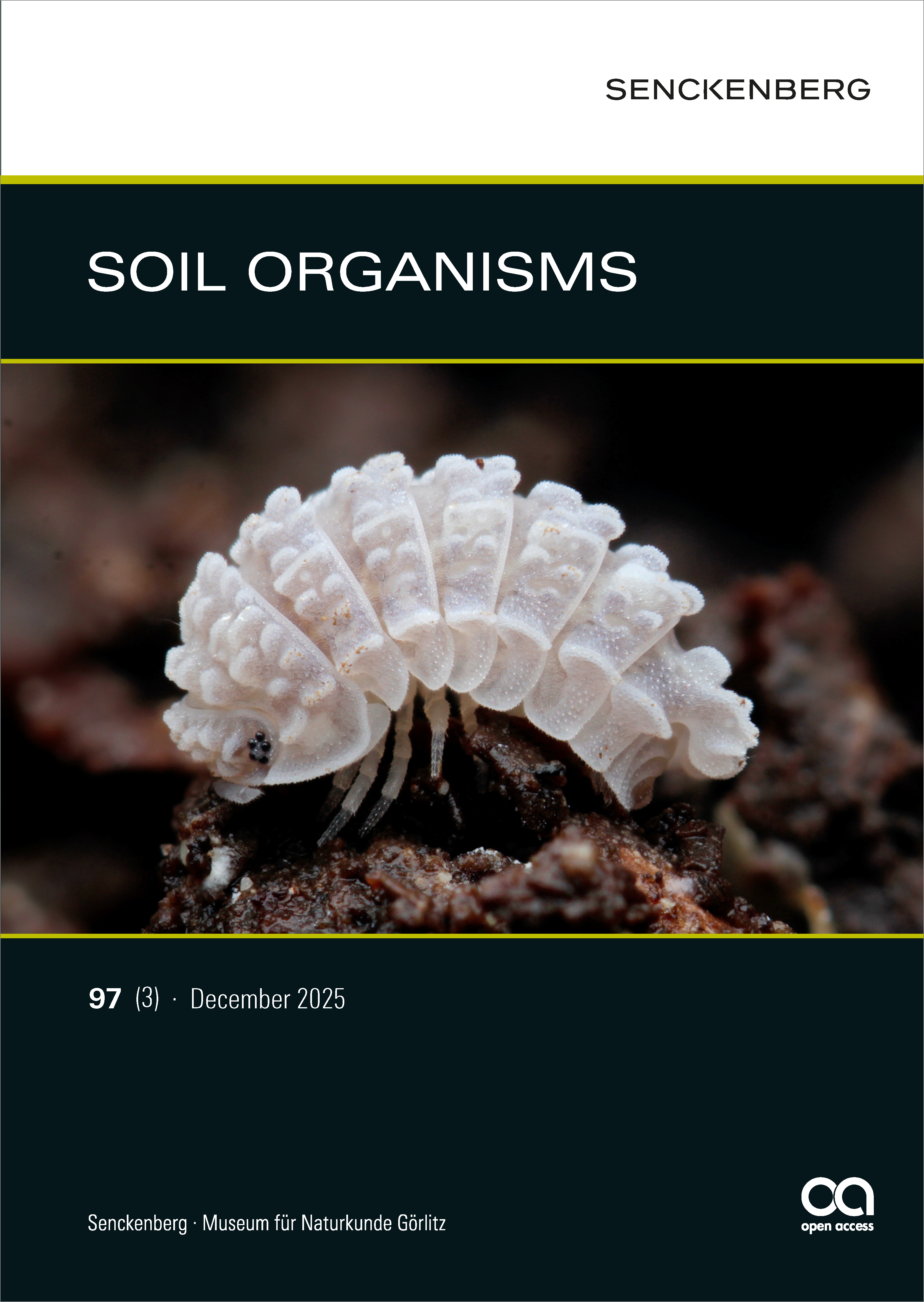
Downloads
Published
Issue
Section
License
Copyright (c) 2025 Marcelo Eduardo Kun, Iris Nadia de la Rosa

This work is licensed under a Creative Commons Attribution 4.0 International License.
Soil Organisms is committed to fair open access publishing. All articles are available online without publication fees. Articles published from Vol. 96 No. 3 (2024) onwards are licensed under the Creative Commons Attribution 4.0 International (CC BY 4.0) license. Articles published from Vol. 80 No. 1 through Vol. 96 No. 2 are available under the previous terms, allowing non-commercial, private, and scientific use.
How to Cite